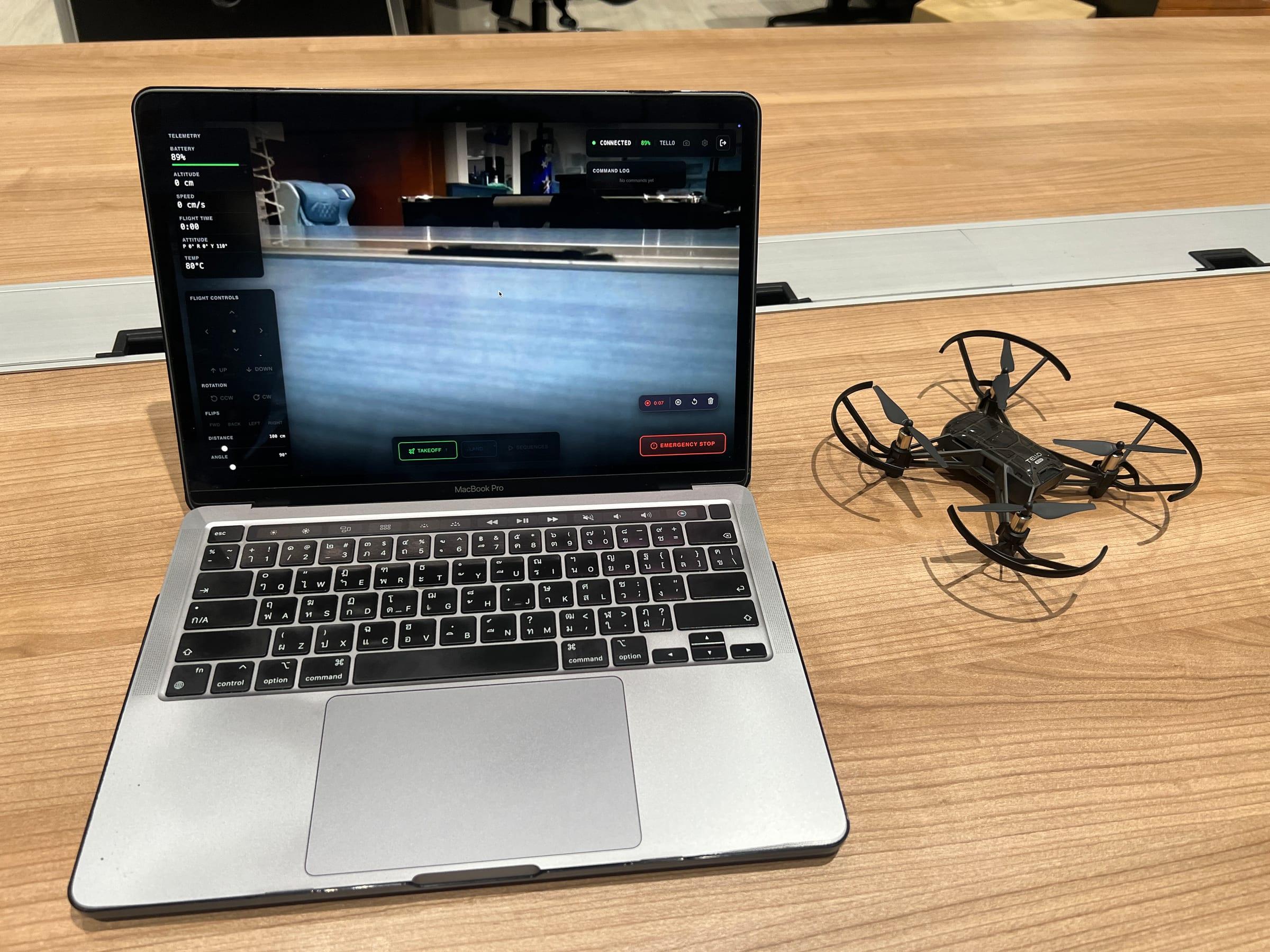
Tello Mission Control is a web app that flies a DJI Tello from the browser. It runs locally, with live video, telemetry and controls on one page.
The shape of it
There are three pieces. A React frontend runs in the browser, a FastAPI backend uses djitellopy, and the drone listens over UDP at 192.168.10.1.
Video is served as MJPEG from /api/video/stream. Telemetry comes over a WebSocket at about 4 Hz: battery, height, flight time, temperature, attitude, speed, barometer and ToF distance. A command log streams the same way. Everything else is a REST call: connect, takeoff, move, rotate, land, emergency stop, disconnect.
One command at a time
The Tello handles one command at a time, while a web UI can send several at once. Overlapping requests can't simply be forwarded, so the backend owns the drone connection and serializes commands with a lock.
The one exception is the one that matters most. The emergency endpoint bypasses all locks.
A drone you don't need
Setting one environment variable runs the whole app with synthetic video and telemetry, so you can work on it with no hardware.SIDENOTEDocker Compose serves the frontend through Nginx on port 3000 and the backend on port 8000. It needs Python 3.12+ and Node 20+.
TELLO_USE_MOCK_DRONE=true docker compose upThe Wi-Fi problem
The Tello creates its own Wi-Fi network, so a laptop connected to it loses internet. There are three ways around that:
- Dual network interfaces, with Wi-Fi to the drone and Ethernet for internet
- A USB Wi-Fi adapter
- A dedicated ground station, such as a Raspberry Pi or NUC, on Wi-Fi to the drone and Ethernet to the LAN, serving the UI at
groundstation.local:3000
Where it stands
The app runs end to end against a real Tello, and the same interface runs against synthetic data in mock mode.
The planner shown on the home page is a demo of where this is heading. Its telemetry values are demo values, and a waypoint planner is part of the autonomous-flight phase on the roadmap.
What's next
The roadmap has six phases:
- Platform hardening: MCP server, flight logging and replay, gamepad, WebRTC
- Computer vision: YOLO overlay, person tracking, optical flow and SLAM, ArUco navigation
- Autonomous flight: waypoint planner, geofencing, auto-land, obstacle avoidance
- An AI agent layer: Claude-powered mission planning, voice control, anomaly narration, auto reports
- Multi-drone and swarm
- Hardware: a Raspberry Pi ground-station image, companion sensors, Home Assistant, 3D-printed mounts
“The single highest-leverage next step.”