You have seen the video. A humanoid folds a towel, loads a dishwasher, makes a bed. It looks finished.
Then it enters a home it has never seen. In a September 2026 test across 30 unfamiliar homes, Figure’s robot completed 56% of its chores.
Meanwhile, Waymo gives more than 500,000 paid rides a week with nobody in the driver’s seat.
Why can a car drive itself across a city while a humanoid struggles with a living room?
The difference is not just intelligence. It is the setting, the task, and how much evidence we have that the machine can handle things going wrong.
From bits to atoms
Physical AI is AI that senses and acts in the real world. It includes factory arms, warehouse robots, robotaxis, drones and humanoids.
A generative model produces an answer. An agent uses software tools to get something done. A physical AI system has to move a body and deal with the consequences.
A wrong draft can be discarded. A robot’s wrong movement can drop a glass, damage a machine or hurt someone. It must react in real time, with limited battery life and hardware that wears out.
The new promise is that one model can learn across many tasks, instead of requiring an engineer to program every movement. The hard part is making that flexibility dependable outside the lab.
Where robots already work
The field moves at three speeds:
- Established work. Factory arms and warehouse robots repeat useful tasks in structured environments. Robotaxis operate commercially too, within defined service areas.
- Expanding services. Delivery drones and driverless trucks have paying customers, but routes, permissions and operating conditions limit where they can go.
- Early general-purpose machines. Humanoids are being shipped, but shipment counts do not tell us how much useful work they do. Research, demonstrations, data collection and factory pilots are different from dependable everyday service.
A fenced factory cell is predictable. A stranger’s kitchen is not. The more controlled the setting, the easier it is to prove a robot can do its job.
That is why a delivery count, a factory output figure or a successful household demo should not be treated as interchangeable evidence of progress.
The seven-layer stack
Whatever the use case, the same seven layers sit underneath. Read this map from the components at the bottom to the teams running the fleet at the top. Companies differ in how many layers they build themselves.
- Compute and parts. Training GPUs, on-robot computers, actuators and batteries provide the processing, movement and power. This is the foundation every other layer depends on.
- Data. Teleoperation, wearable cameras, human video and fleet logs provide examples of tasks, movements and failures. Collection and curation turn that experience into training material.
- Simulation and world models. Physics simulators let robots practise in virtual environments. Learned world models predict what could happen next and help screen models before costly physical trials.
- Models. The learned policy connects observations and instructions to actions. Vision-language-action models and world-action models are two approaches to deciding what a machine should do next.
- Bodies. Arms, vehicles, humanoids and hands turn commands into physical work. Sensors, touch and whole-body control connect the policy to the machine’s actual movement.
- Deployment. Site preparation, integration with existing systems and safety assessment make the robot usable for a particular customer and task.
- Operations. Fleet monitoring, remote assistance, maintenance and software updates keep machines working after installation. Failures and interventions feed the next round of learning.
The lower layers make a capable machine possible. Deployment and operations determine whether it can keep working at a customer’s site.
Inside the robot: three control loops
The seven layers describe the wider system. Inside the machine, it helps to think in three loops:
- Plan: understand the scene and choose the next step.
- Act: turn observations into movements.
- Control: maintain balance, contact and force as the body moves.
Figure’s Helix 02 is one published example of this layered approach. Its planning, action and whole-body control run at different speeds. Other systems divide the work differently.
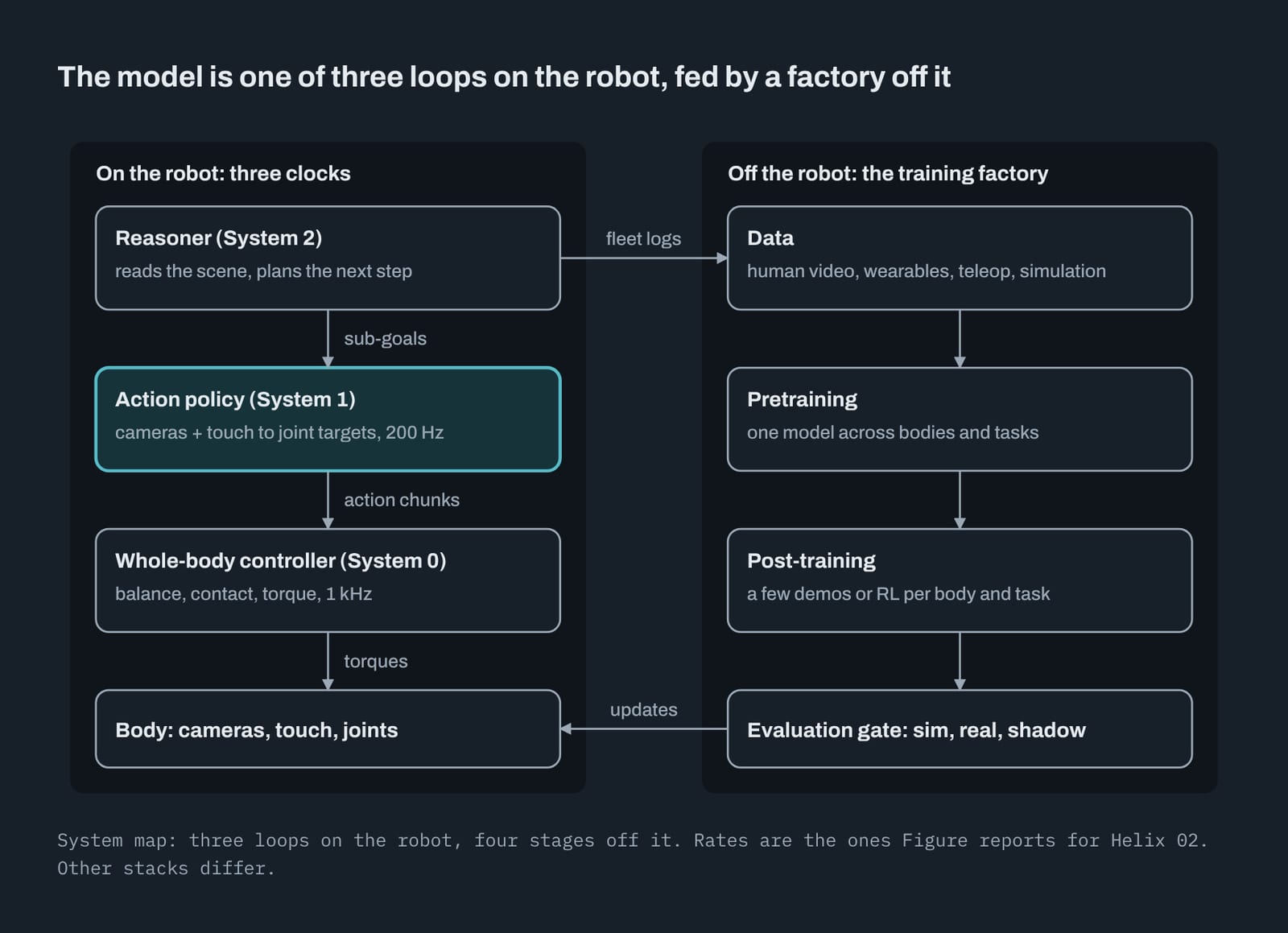
The diagram’s right side shows the work off the robot: collect data, train a model, adapt it to a body and task, and evaluate it before sending it to the fleet.
A more capable model helps. It does not remove the need for reliable hardware, good tests or a safe deployment.
The loop that makes robots better
A deployed robot is also a source of learning. Its successes, failures and requests for help can feed the next version.
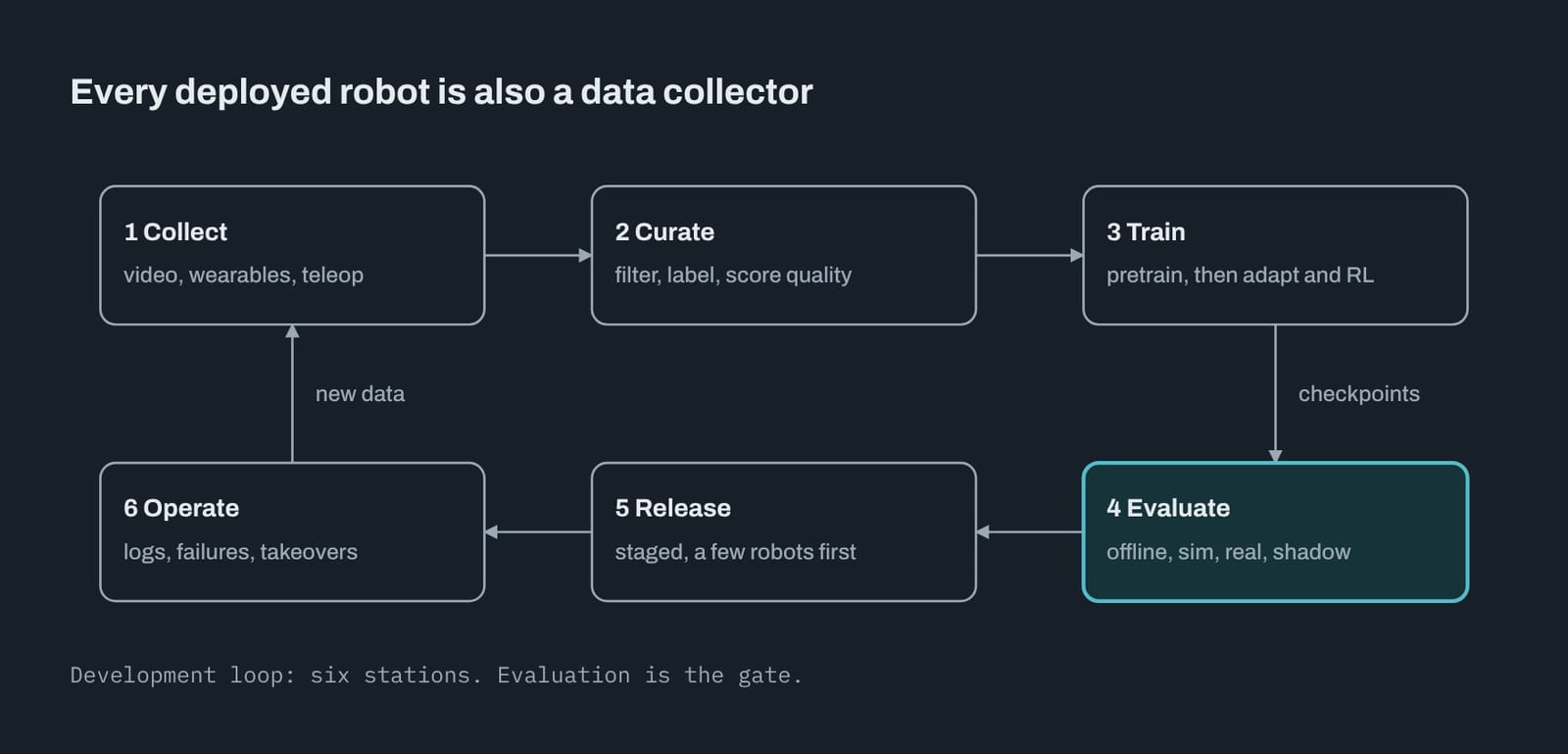
The loop is simple to describe: collect experience, filter it, train, evaluate, release to a few machines, and observe what happens.
The difficult step is knowing whether the new version is actually better. 1X has described why lower training loss does not reliably predict better real-world performance. Teams still need physical trials, not just a better number on a training dashboard.
Simulation helps narrow the search. It is especially useful for repeated practice, but cloth, friction and delicate contact remain hard to reproduce. A convincing simulated result still needs a real-world check.
People are still part of the system
Behind an autonomous-looking robot may be someone demonstrating tasks, reviewing data, approving an update or helping when it gets stuck.
Those roles are not all the same. Teleoperation means a person drives the robot. Remote assistance means the machine keeps control and asks for advice. Waymo describes its remote support as advice, not steering.
The practical question is how often help is needed, and how many machines one person can support. A robot that needs constant rescue may perform a task without making that task economical.
Human corrections can also be valuable training examples. They show what to do at the exact point where the robot failed. The goal is for those interventions to become less frequent as the system improves.
What is still hard, layer by layer
Each layer has its own bottleneck. These are the few challenges that matter most:
- Compute and parts: cost, power and response time. Joints are expensive, batteries limit useful working time, and larger models take longer to react. Battery swaps and smaller, faster control models help, but hardware constraints remain.
- Data: useful experience is hard to collect. Teleoperation is slow, while ordinary video does not capture contact forces. Teams combine human footage, robot demonstrations and corrections, with careful quality checks.
- Simulation and world models: contact is difficult to reproduce. Cloth, friction and delicate handling remain hard to model. Simulation can narrow the search, but plausible virtual results still need confirmation on real robots.
- Models: generalisation and consistency. A robot must handle unfamiliar tasks and succeed repeatedly. Human coaching and learning from failed attempts help, but strong results on selected lab tasks do not establish reliability in new homes.
- Bodies: dexterity must survive daily use. Hands need both sensitive touch and durable mechanics. Better sensing and learned control help; long-term failure and maintenance data are still needed.
- Deployment: every site changes the job. Integration and safety depend on the application and surroundings. Constrained tasks and conventional safety controls help, while changing model behaviour makes assurance harder.
- Operations: rare failures and fleet-wide risk. Unexpected situations still require help, and one bad update can affect many robots. Staged releases, monitoring and remote assistance limit exposure; intervention rates show whether the service is becoming easier to run.
Progress in one layer does not solve the others. A stronger model still needs a durable body, a suitable site and a team that can recover from failures.
What separates a demo from a service
Five questions matter more than another impressive video:
- Does it work somewhere new? Success on a rehearsed task does not show how well it handles unfamiliar objects or rooms.
- Does it keep working? Look for failures, interruptions and human interventions over time.
- Is it safe in this setting? A factory cell and a family kitchen need different protections.
- Does it fit the customer’s work? Someone must handle installation, existing systems, maintenance and recovery.
- Can it scale? More robots should not require a matching increase in operators. Updates also need to reach the fleet safely.
Customers need evidence about the whole system. How often does it fail? What happens next? Who is responsible for getting it running again?
What I will watch next
I will pay more attention to three measures than to shipment targets:
- Useful work: robots doing paid, repeated tasks at customer sites.
- Less intervention: fewer rescues and more machines supported by each operator.
- Lasting reliability: performance measured across real shifts and changing conditions.
This is also where much of the engineering work sits: deployment, fleet monitoring, testing, incident recovery and safe updates.
People who have run software and connected equipment in buildings or factories already know parts of this problem. The job is to make a system work every day, understand when it does not, and improve it without breaking what already works.
So back to the bed. A robot will earn our trust when making it is a dependable service, not a memorable demonstration.
Primary sources worth reading in full: the IFR World Robotics 2026 summary, NVIDIA’s GR00T 2 page, the π0.7 paper, the RECAP paper, RoboArena and SAFE.